
Case Study - Enterprise AI Systems Architecture & Operational Integration Framework
Architecting a phased AI systems integration framework across 15 enterprise platforms for a multi-regional commercial real estate management company — from discovery through deployment specification.
- Client
- Commercial Real Estate Management Company
- Year
- Service
- Systems Architecture, Enterprise Integration, Operational Safeguards
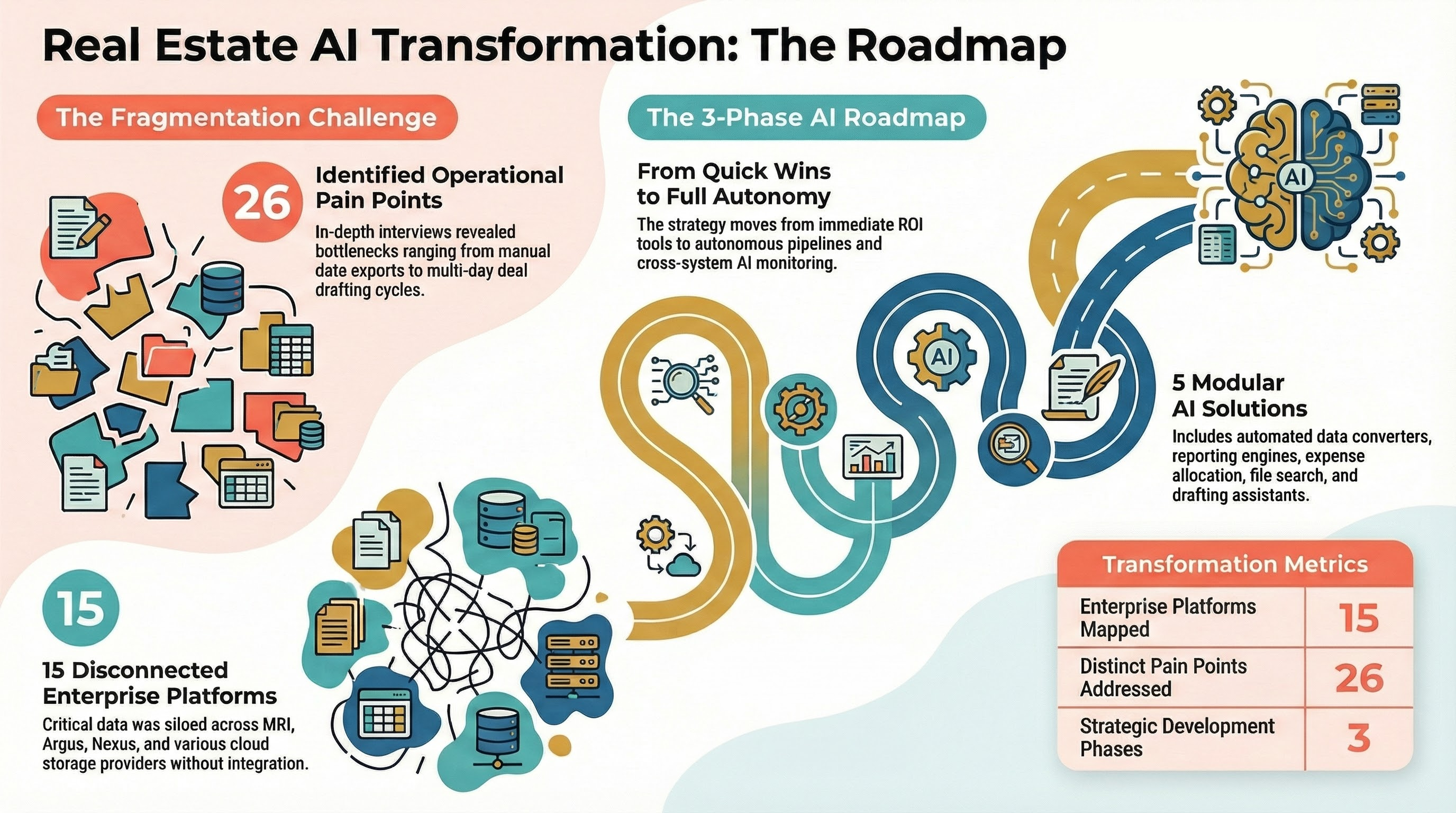
System Architecture Snapshot
- Data Layer — 15 enterprise platform integrations (MRI, Argus, Nexus, Certify, SharePoint, Box, ADP)
- Processing Layer — Many-to-many converter framework, automated reporting engine, expense allocation
- Control Layer — Integration complexity matrix, risk mitigation, admin access controls
- Orchestration Layer — 3-phase rollout from manual converters to autonomous pipelines
Executive Summary
A commercial real estate investment and management firm operated across multiple regions with teams spanning Accounting, Asset Management, Property Management, HR, Construction, and Finance. Operations ran on a patchwork of disconnected enterprise systems with no integration or automation between them.
BeeNex architected a phased AI integration framework that turned 26 identified pain points into 5 modular solutions — from quick wins to full autonomous pipelines.
The Challenge
The client's workflows depended on MRI, Argus, Nexus, Certify, SharePoint, ShareFile, Box, Dropbox, ADP, and Excel. Nearly every process required manual exports, reformatting, copy-pasting, and cleanup before data could be used for reporting, valuations, or decision-making.
After conducting 16 in-depth interviews across every department and collecting structured survey responses, BeeNex identified 26 distinct pain points — from messy MRI-to-Excel exports affecting 10+ employees, to scattered file management across 5 different platforms, to days-long deal memo drafting cycles.
The core problem wasn't any single tool. It was the absence of integration and automation between them.
The Approach
BeeNex structured the engagement around five modular solutions, each addressing a cluster of related pain points:
Many-to-Many Converter Framework - A drag-and-drop tool that takes raw exports from MRI, Argus, Nexus, and Certify and outputs clean, template-ready Excel/CSV files. Later evolving into scheduled, autonomous pipelines.
Reporting Automation Engine - Auto-refreshing variance reports, aging reports, and business plan templates with AI-generated variance explanations in plain English.
Expense Allocation Engine - Rules-based allocation of expenses across properties with AI validation for GL code mismatches, replacing the manual Nexus/Certify upload workflow.
AI File Search & Management - Unifying files from SharePoint, ShareFile, Box, and Dropbox into a single searchable repository with auto-tagging and an AI-powered search/chat interface.
Deal Memo Drafting Assistant - An AI chat interface that ingests Argus/MRI/Excel data and generates 75%-complete first drafts of deal memos and business plans.
Each solution was scoped with a detailed integration complexity matrix covering 15 software platforms, their API availability, key setup requirements, and risk factors.
Key Deliverables
- Full pain point analysis with value and complexity scoring across 26 identified problems
- 5 modular solution architectures with phased rollout strategy
- Integration complexity matrix for 15 enterprise platforms
- Executive-ready proposal with risk mitigation and admin access strategy
- 3-phase roadmap: Quick wins → Autonomous pipelines + AI → Full RAG and cross-system monitoring
- MRI API/ODBC
- Argus
- Nexus/Certify
- Azure Functions
- Azure OpenAI
- Azure Cognitive Search
- Power BI
- Power Automate
- SharePoint API
- Box API
- Excel (Office Scripts/VBA)
Results & Impact
- Pain points identified & addressed
- 26
- Enterprise platforms mapped
- 15
- Modular solutions designed
- 5
- Incremental rollout roadmap
- 3-phase
Projected hours saved weekly across Accounting, Asset Management, HR, and Property Management were quantified. Manual errors in allocations, reporting, and data exports were reduced. Reporting cycles for leadership visibility were shortened. A clear, budgeted transformation roadmap was delivered that the executive team could approve incrementally.
The framework balances immediate operational gains with a clear pathway to full automation. Each solution builds reusable components that reduce cost and complexity in subsequent phases.