
Case Study - Full-Stack Edge AI Product Engineering — Hardware to Market
Engineering the complete product stack for a revolutionary edge AI device — from hardware-software integration and firmware optimization to product site, investor materials, and go-to-market infrastructure.
- Client
- Luna AI
- Year
- Service
- Product Engineering, Hardware-Software Integration, Product Site, Investor Materials, Go-to-Market
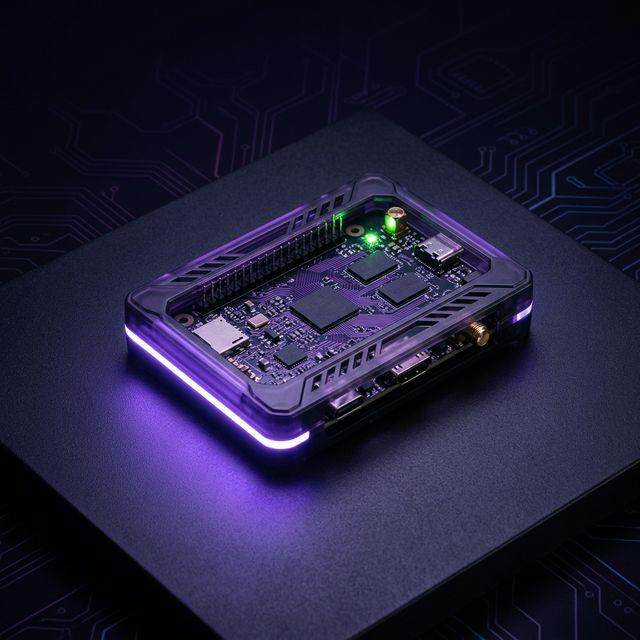
Results at a Glance
Product Engineering: Delivered the full product stack for an edge AI hardware device — from firmware-level optimization and model tuning to a production-grade product site with interactive performance benchmarks, a 5-year TCO calculator, and investor-facing materials. Unified the engineering, brand, and market narrative into a single cohesive product identity.
Impact: Positioned Luna AI as a credible entrant in the enterprise edge AI market with a vertically integrated product story — custom hardware, proprietary firmware, tuned models, and a market-ready digital presence — ready for investor engagement and early customer acquisition.
The Challenge
Edge AI hardware is a field dominated by established players like NVIDIA. Luna AI had a genuine technical breakthrough — a compact device delivering 400 tokens/second prefill speed on a 1–5W power envelope — but needed to translate raw hardware R&D into a complete, market-ready product.
The specific challenges:
- Hardware-software integration — Custom hardware with an 8-core CPU and 3-core NPU required proprietary firmware optimized for AI inference workloads
- Performance positioning — Demonstrating 6x speed advantage over NVIDIA Jetson Orin Nano required rigorous benchmarking and clear communication
- Cost narrative — The zero-cloud, zero-recurring-cost model needed to be quantified against AWS/Azure alternatives over enterprise deployment timelines
- Investor readiness — Technical capabilities needed translation into market terms: TAM ($24B), unit economics (65–75% gross margins), and regulatory compliance (GDPR/HIPAA)
- Product identity — Moving from engineering prototype to a product with a compelling digital presence and brand
The Solution
BeeNex engineered the complete product stack — taking Luna from hardware prototype to market-ready product with a unified technical and commercial identity.
Hardware-Software Integration
Worked alongside the Luna engineering team to integrate custom hardware with proprietary firmware, ensuring the 8-core CPU and 3-core NPU architecture was fully optimized for AI inference. The tuned software stack delivers 400 tokens/second prefill and 20–25 tokens/second generation for 1B parameter models — all within a 62-gram, 1–5W power envelope.
Performance Benchmarking & Competitive Positioning
Built rigorous benchmark infrastructure comparing Luna against NVIDIA Jetson Orin Nano (67 t/s prefill) and cloud solutions. Engineered interactive visualizations that make the 6x speed advantage immediately tangible, with side-by-side latency and throughput comparisons.
Product Site & Interactive Tools
Designed and built the Luna product site featuring an interactive TCO calculator that lets prospects model 5-year deployment costs against AWS/Azure, a competitive analysis matrix spanning latency, privacy, resilience, and cost dimensions, and a savings calculator for fleet deployments. The site serves both investor and customer audiences with a single, cohesive narrative.
Investor Materials & Go-to-Market Infrastructure
Translated technical specifications into investor-ready materials — addressable market sizing, unit economics modeling, competitive moat articulation, and regulatory compliance documentation. Built the waitlist and investor meeting scheduling infrastructure to support early traction.
- Edge AI Architecture
- Hardware-Software Integration
- Firmware Optimization
- Product Site Engineering
- Interactive Data Visualization
- Investor Materials
- TCO Modeling
- Go-to-Market Infrastructure
Results
- Prefill inference speed achieved
- 400 t/s
- Faster than NVIDIA Jetson Orin Nano
- 6x
- Lower 5-year TCO vs cloud deployment
- ~98%
- Total device power consumption
- 1–5W
Luna AI went from a hardware breakthrough to a market-ready product with a unified identity — custom hardware, proprietary firmware, tuned models, and a digital presence that speaks to both investors and enterprise buyers. The edge doesn't need the cloud. It just needed the right product engineering.